
Illustrative sample
Tour-ready deployment
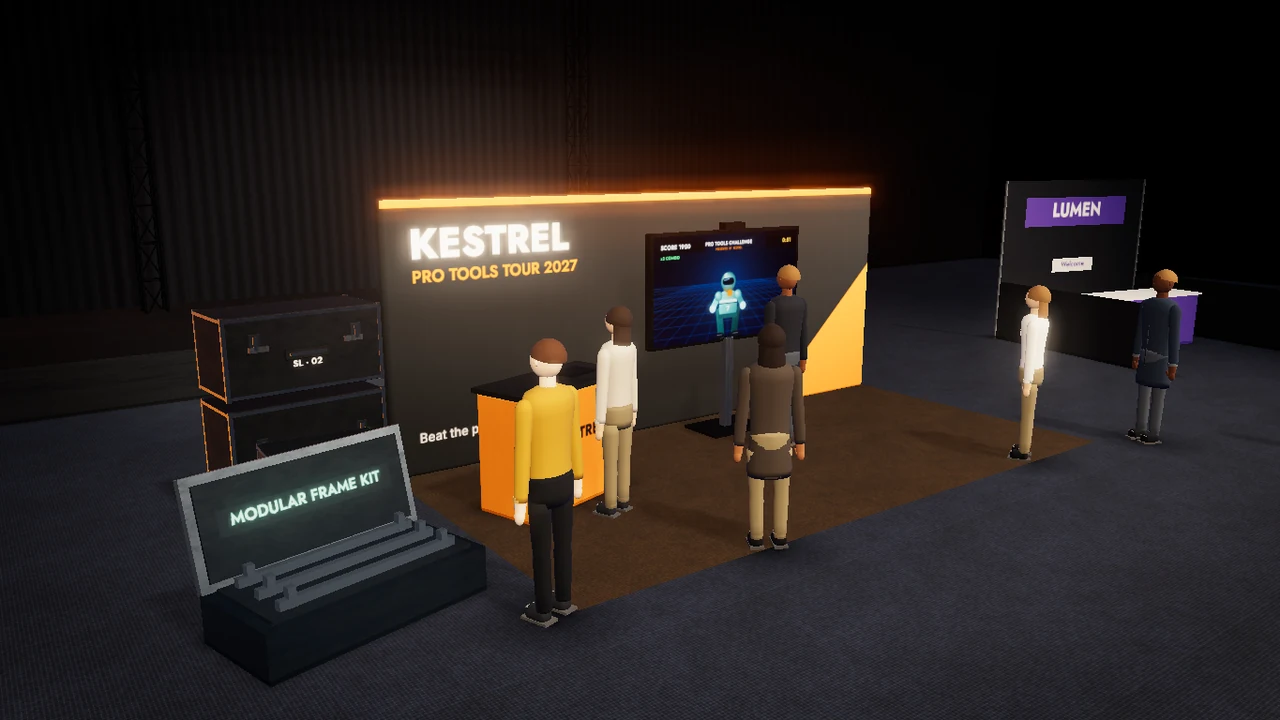
The illustrated kit packages a compact interactive booth with branded panels, road cases and a repeatable setup plan.
The guest journey
A clear way in.
A reason to stay.
Plan the route
Confirm dates, floor plans, languages and each venue’s service requirements.
Pack the experience
Protect the hardware and make assembly and checks repeatable.
Open the next stop
Install, calibrate and check the guest flow before the doors open.
Learn and travel
Record faults and results, then pack for the next venue.
Existing capability
Shows have been packaged and deployed across three cities.
Developed for your version
Your touring hardware, case layout, crew plan and adaptations are scoped around the selected build.
The practical details
Make room for
the whole experience.
These are planning assumptions for the sample. Your venue, audience and operating hours shape the final specification.
- Space & power
- Example: a 10 × 10 or 10 × 20 ft booth. Footprint, loading access and power follow the experience selected.
- Guests & pace
- Capacity follows the underlying game and the venue layout; the touring label does not create a separate throughput promise.
- People to run it
- Choose a studio-crewed or trained-operator plan; responsibilities and response cover must be agreed.
- Venue checks
- Venue access, union/service rules and shipping lead times vary by stop.
- Specify who stores, insures, inventories and repairs the kit between events.
- Budget recurring connectivity, consumables and creative changes separately from the original build.
Creative directions
Your story changes everything.
These fictional directions show how the format can serve a different brief.
A consistent fan tour
Keep the core game while updating team or city creative.
A campus circuit
Adapt language and host cues around a repeatable compact booth.
A trade-show season
Reuse the hardware across a planned annual event calendar.
What we build for your brief
Three studio workstreams shape this direction. Your proposal defines the final deliverables and keeps vendor costs separate.
- The repeatable deployment
Plan how the selected experience assembles, calibrates and packs at each stop.
- The stop-specific creative
Scope agreed city, language or campaign variations around the existing build.
- The operating handoff
Define checks, fault reporting and the chosen studio-crewed or trained-operator arrangement.
Studio planning allowance · CAD
Added to the chosen build
Planning allowance in CAD, before HST. Studio creative and software are separate from third-party hardware, fabrication and site costs. Final scope and live operating hours are agreed in the proposal.
Third-party costs. Cases, freight, storage, crew, travel, venue services and replacement stock are quoted against the route.
Schedule. Set with the underlying build · allow route planning and repeat-site validation.
Download producer briefDuring the run—and after it
A touring proposal separates initial packaging from the per-stop cost: freight, setup/strike, crew, travel, venue services and support. Setup estimates only follow a chosen build and an accessible load-in route.
What the recap can tell you
Consistent play and operational measures make stops comparable. The recap notes differences in opening hours, footfall and venue layout alongside the results.
Make it your own
Bring the brief.
We’ll shape the possibilities.
Tell us the audience, the moment and what you want them to do. A venue or final budget can come later.